
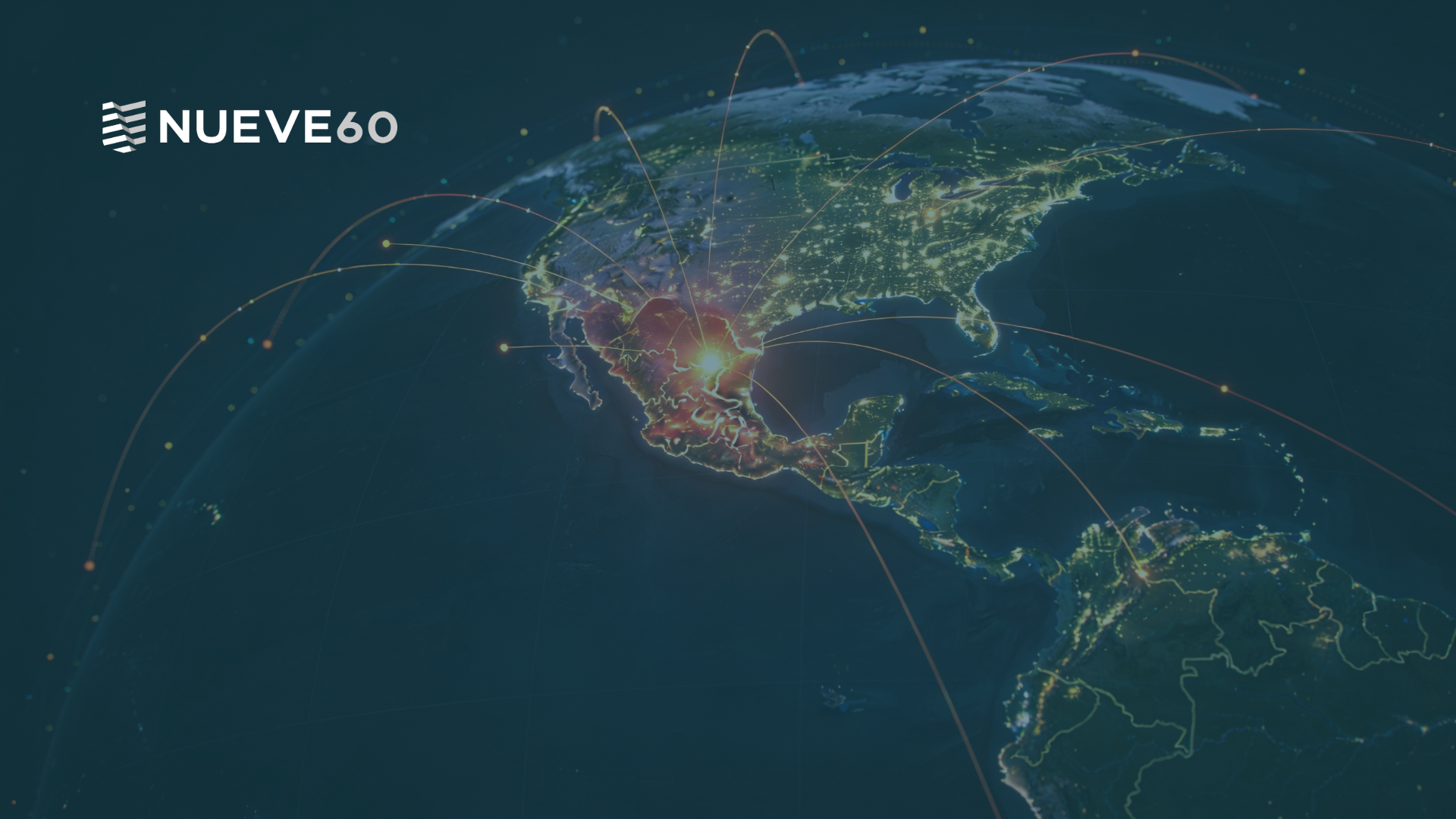
Mexico: The Gateway to LATAM Growth
Por NUEVE60
U.S. and European companies are choosing Mexico as their expansion hub. The key is setting up your company with full legal and tax certainty.
Mexico is rapidly emerging as one of the most attractive destinations for foreign investment in the Western Hemisphere. For U.S. and European companies seeking to expand operations, diversify supply chains and access new consumer markets, Mexico offers compelling advantages rooted in geography, trade policy and a significant nearshoring trend. However, strategic opportunity must be paired with the right legal and tax framework to ensure sustainable success.
1) Nearshoring Drives Foreign Direct Investment
One of the most visible drivers of Mexico’s economic ascent has been the nearshoring trend—the relocation of manufacturing and operational capacity closer to key consumer markets, particularly the United States.
According to official data compiled by Mexico’s Secretaría de Economía, the country attracted a record foreign direct investment (FDI) of approximately $40.9 billion USD in the first nine months of 2025, marking the highest inflows ever recorded for that period and highlighting rising investor confidence. Much of this capital is being funneled into manufacturing, electronics and energy-related sectors—areas that benefit most from proximity to U.S. markets. *Mexico Affairs
Similarly, data from 2025 indicate that total FDI reached about $21.4 billion in the first quarter of the year, a 5.4 % increase from the previous year, with U.S. companies alone contributing nearly 38.7 % of the total investment. These figures underscore Mexico’s growing appeal as a nearshoring destination that offers cost advantages and logistical efficiency over distant alternatives. *IndexBox
Why it matters:
- Proximity to the United States means shorter transit times (2–5 days by truck vs. 15–30+ from Asia) and lower freight costs.
- Mexico’s manufacturing sector is a critical link in North American supply chains.
- Nearshoring inflows are signaling long-term strategic repositioning rather than temporary spikes.
2) Strategic Location and Trade Agreements
Mexico’s geographic position as a bridge between North and South America gives companies operating there unrivaled access to multiple regional markets. Its integration with North American supply chains—primarily through the United States–Mexico–Canada Agreement (USMCA)—provides tariff efficiencies and regulatory predictability that are especially valuable in sectors like automotive and electronics.
Additionally, Mexico has a broad network of free trade agreements (FTAs) covering Europe, Latin America and Pacific-Asia, expanding access beyond North America and creating an attractive export platform for foreign companies. These trade relationships allow investors to leverage Mexico as a launchpad into broader LATAM markets, rather than a destination confined to a single region.
Why it matters:
- Mexican export products benefit from preferential trade treatment in major markets.
- U.S. and European firms can export to multiple countries without incurring additional tariffs.
- The value of integrated supply chains has become more salient amid global trade volatility.
3) Economic Fundamentals and Investment Volume
Mexico’s macroeconomic profile supports its role as a growth hub. The country consistently ranks among the top recipients of FDI in the region. According to UNCTAD’s World Investment Report 2024, Mexico was the ninth-largest global recipient of foreign direct investment in 2023, with total FDI stocks reaching approximately $778 billion USD. *comercioexterior.bbva.es
Beyond sheer volume, the composition of foreign investment reveals strategic intent:
- Automotive manufacturers from Germany and Japan, such as Volkswagen and Toyota, have expanded their Mexican operations to serve regional and global markets.
- Major U.S. manufacturers are increasingly shifting production and logistics footprints to Mexico to mitigate supply chain risk and improve responsiveness to market demand.
These developments signal more than capital flows—they reflect strategic long-term business commitments by global corporations that see Mexico as not only a manufacturing base, but a regional operations hub.
4) The Legal & Fiscal Imperative for Success
Despite macroeconomic promise, opportunity alone is not sufficient. For foreign investors, the decisive factor in translating opportunity into sustainable business performance lies in legal certainty and tax strategy.
Mexico’s regulatory environment combines federal and state laws that influence corporate structure, compliance requirements, labor laws and tax obligations. An investor who fails to properly navigate this landscape may face:
- Unexpected tax liabilities
- Compliance penalties
- Structural disadvantages compared to domestic competitors
This makes legal planning and corporate structuring—from entity choice to shareholder agreements and cross-border tax planning—an essential priority for any company entering the Mexican market. Proper planning reduces risk, enhances operational predictability and lays the groundwork for expansion beyond the initial investment.
Mexico’s position as a gateway to Latin American growth is no longer theoretical — it is measurable in billions of dollars of investment, increasing corporate commitments, and expanding roles in global supply chains. Nearshoring, geographic advantages and a robust network of trade agreements have created fertile ground for foreign direct investment from the United States and Europe.
However, strategic entry must be paired with legal and fiscal clarity to ensure that investors fully harness the opportunity without unnecessary risk. For companies seeking to expand beyond their home markets in 2026 and beyond, Mexico offers not just access to new markets — but a structured platform for sustainable regional leadership.
*Sources
- Mexico attracted roughly $40.9 billion in FDI during the first nine months of 2025, the highest for that period, driven by nearshoring trends. Mexico Affairs
https://mexico.affairs.media/mexico-record-fdi-2025
- FDI in Q1 2025 hit $21.4 billion, with U.S. firms contributing nearly 38.7 % of total inflows. IndexBox
- Mexico ranked as the 9th-largest global FDI recipient in 2023, with a total inward stock of approximately $778 billion. comercioexterior.bbva.es
https://comercioexterior.bbva.es/en/country-profiles/mex
Discover how legal structure, tax clarity, and strategic planning define success in Mexico.
Follow NUEVE60 for expert insights on international expansion.